For Glen & Pam Hopkinson, their children, and all their posterity — through Glen
Hannah Emerson was born in Haverhill in 1657 and married Thomas Duston. In March 1697, during King William’s War, she was taken from her house with her newborn and her nurse. She is Todd Hopkinson’s 9th great-grandmother, on Glen’s side only, through Vivian Hamblin. Pam’s line does not come through her. The story includes the killing of a newborn, and the killing of Native adults and children.
Born 1657, HaverhillRaid 15 March 1697Mather’s date: 30 AprilBounty £50Died in the mid-1730s
Why she is here
Glen’s 8th great-grandmotherthrough their son Jonathan, then the Hamblin line
A 9th great-grandmother to Glen and Pam’s childrenincluding Todd · not through Pam
A 10th great-grandmother to the grandchildrenFamilySearch relationship, checked 4 October 2026
Still argued
When she died, and wheremid-1730s · Haverhill or Ipswich · 1736, 1737, or 1738
The night of the killingMather says 30 April · others say 30 March or 29 April
Where on the river it wasan island at Boscawen is the tradition, not a place Mather mapped
Before the story. What follows includes the killing of a newborn, and the killing of Native adults and children in a sleeping household. The earliest printed account does not look away from either, and this page does not either. It is a frontier war story: a town attacked, a baby killed on the march, and then ten people killed by the captives who expected worse ahead. Colonial Massachusetts paid for the scalps. Later Americans put a woman with a hatchet on a pedestal. Both of those facts stay in the telling.
At a glance
What is known, and what is not
The surname moves around in the records: Duston, Dustin, Dustan, and others. Cotton Mather’s reprints use Dustan. This page uses Duston except when it is quoting. She left no story in her own hand. There is no evidence she could write. Almost everything sharp in the 1697 account is Mather’s.
Her life sits in the early Massachusetts frontier, well after the Mayflower generation. A fuller page for that era is still to come. This one is only hers.
Dates are Old Style, as the sources give them. The cards are the events. Where the books disagree — a date, a count, a place, the bounty, a statue — the argument is a note, not a second card.
Southern New England nations are shattered. Many survivors join Abenaki and other northern nations allied with the French. That is the background of the next war’s raids, not yet Hannah’s story.
The North American front of a European war. French-allied raids hit English towns. Colonial governments pay for Native scalps.
8 June 1693
Her sister Elizabeth is hanged
For concealing the deaths of illegitimate twin daughters. Not Hannah’s case.10
The raid and the river March–June 1697
15 Mar 1697
The raid on the skirts of Haverhill
Hannah had lain in about a week, with her nurse, the widow Mary Neff. Thomas gets the older children to a garrison. The newborn is killed on the march. Houses burn.3
“On March 15, 1697, the Salvages made a Descent upon the Skirts of Haverhill, Murdering and Captivating about Thirty-Nine Persons, and Burning about Half a Dozen Houses.”
Cotton Mather, Decennium Luctuosum (1699), original spelling
The march
North, toward a town they have not reached
About a dozen miles that first night, then about 150 miles. The family holding them is taking them somewhere beyond Penacook, where the women are told they will be stripped, scourged, and made to run the gauntlet.6
30 Apr 1697
Before dawn, by Mather’s date
Ten of the sleeping household are killed. One woman escapes, badly wounded. One boy, meant to be kept asleep, wakes and runs. The three captives take ten scalps. Mather compares Hannah’s part to Jael killing Sisera.5, 7
“But on April 30”
Cotton Mather, Decennium Luctuosum (1699). The same date is in the Magnalia reprint read for this page.
6 May 1697
Mather preaches the story
In Boston. Hannah is said to have been in the congregation.11
12 May 1697
Hannah tells Sewall
She comes to his house in Boston. He writes down what she says, and gives her some Connecticut flax. It is the closest thing to an account in her own words.5
16 June 1697
The province votes £50
£25 for Hannah, through Thomas, and £12 10s each for Mary Neff and Samuel. The scalp law had already lapsed.8
A long, quiet life 1698–1730s
1699
The story is in print
Mather’s Decennium Luctuosum carries “A Notable Exploit.” Hannah Heath Bradley, taken in the same raid, is ransomed and home.
1702
Magnalia Christi Americana
The story again: “A Notable Exploit; Dux Fæmina Facti” — a woman was leader of the deed. Then it largely drops out of mind until the 1820s.
1704, 1707, 1708
Haverhill is raided again
In Queen Anne’s War. The town was still a target.19
11 May 1718
Samuel Lennardson dies
The English youth in Mather’s account. The name is later writers’.12
17 Oct 1722
Mary Neff dies at Haverhill
Hannah’s nurse, and a captive with her on the river.13
Year and town unsettled. The careful date is the mid-1730s.9
Forgotten, then carved in stone 1821–today
1821
The legend starts up again
Timothy Dwight retells it, then Whittier, Hawthorne, and Thoreau. The revival sits in the decades of Indian removal, and many retellings leave out the killing of Native children.
1847
Stearns paints the scene
Hannah Duston Killing the Indians. A theater picture, not an eyewitness view.7
1861–65
A column that did not stay
A marble column went up at the Haverhill capture site in 1861, was never fully paid for, and in 1865 was sold to Barre, Massachusetts, as a Civil War memorial.
17 June 1874
The Boscawen statue
On the island at the Contoocook. She is shown with a hatchet and scalps.16
1879
The Haverhill bronze
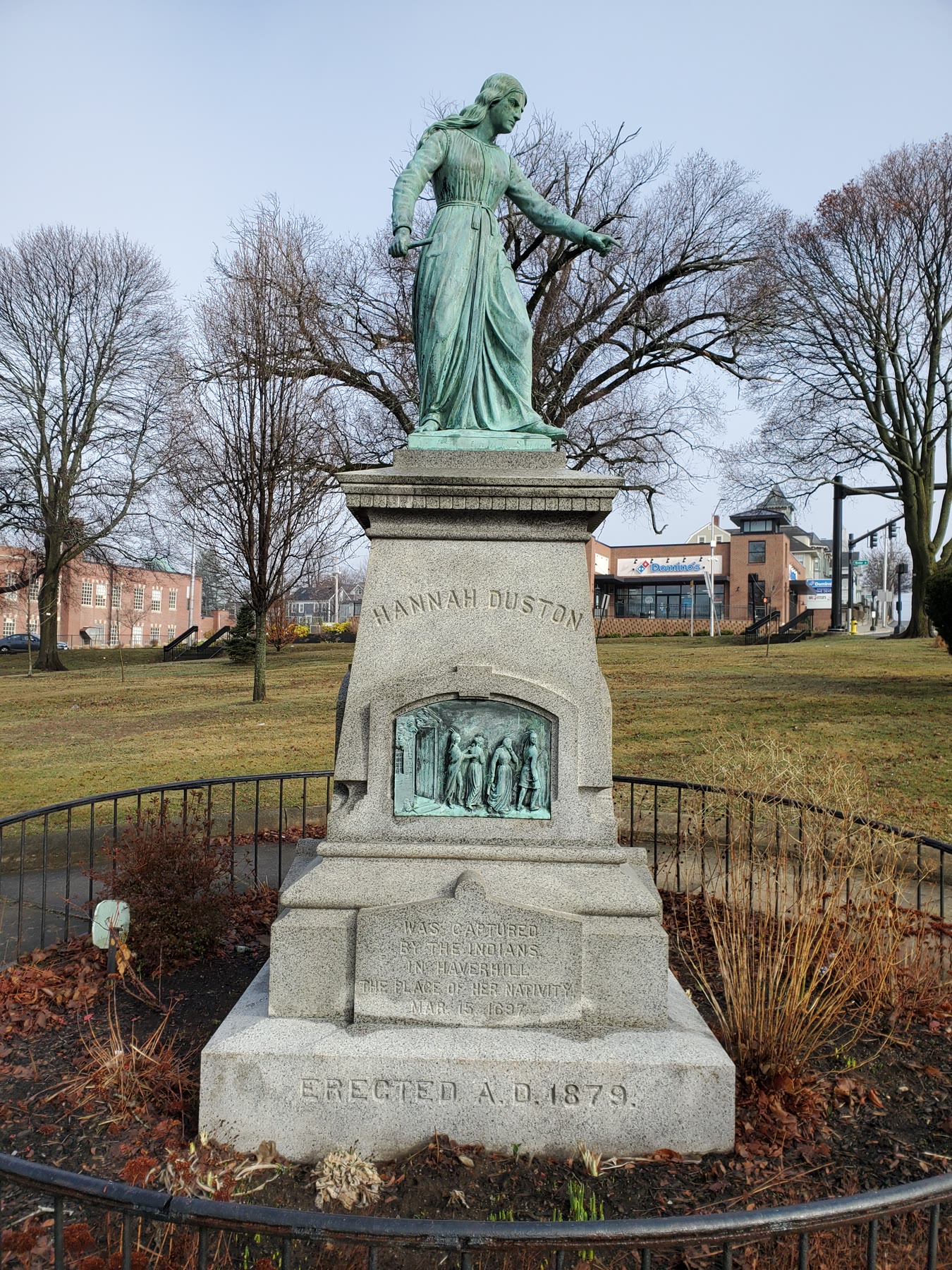
In Grand Army Park, on the site of the church she joined.17
1902–1910
Stones along the story
A DAR marker at Nashua, a millstone for a traditional landing on the Haverhill shore, a 1908 boulder said to mark Hannah and the baby at Jonathan’s farm, and a 1910 tablet for Lennardson at Worcester, later reported stolen.
2020–21
Haverhill keeps its statue
The council votes to keep the bronze and to change wording on the base.18
2025–26
Boscawen: a removal bill fails
House Bill 1664 is voted inexpedient to legislate on 12 February 2026, 194–156. The statue stays. Abenaki leaders had asked that the history remain and the Indigenous side be told. The monument is vandalized again in late April 2026.
Geography
Where it happened
Two geographies stay separate. Mather’s party is being taken somewhere beyond Penacook, and when the killing happens he still has them about 150 miles short of it. The island at Boscawen is where later memory, and the 1874 statue, put the night.6 The map is a sketch, not a surveyed track. There is no pin for Mather’s unnamed town.
Captives going north, March 1697 (traditional corridor, not Mather’s survey)Canoe home, in later tradition — Mather does not mention a canoe
15 MarchThe Haverhill house
Hannah, the newborn, and Mary Neff are taken. Thomas is away at work.
Same morningA garrison, a mile or two
Mather: the older children run, and Thomas stays at the rear of all of them.
The marchUp the Merrimack
North. Route traditional. Mather’s “150 miles” is a story distance.
TraditionIsland at the Contoocook
Boscawen. The 1874 statue. Not a coordinate Mather printed.
Not reachedBeyond Penacook
The town they were told they were going to. No pin. No name in Mather.
Later tellingCanoe downriver
Nights only. A possible night at Lovewell’s in old Dunstable, on a marker dated March.
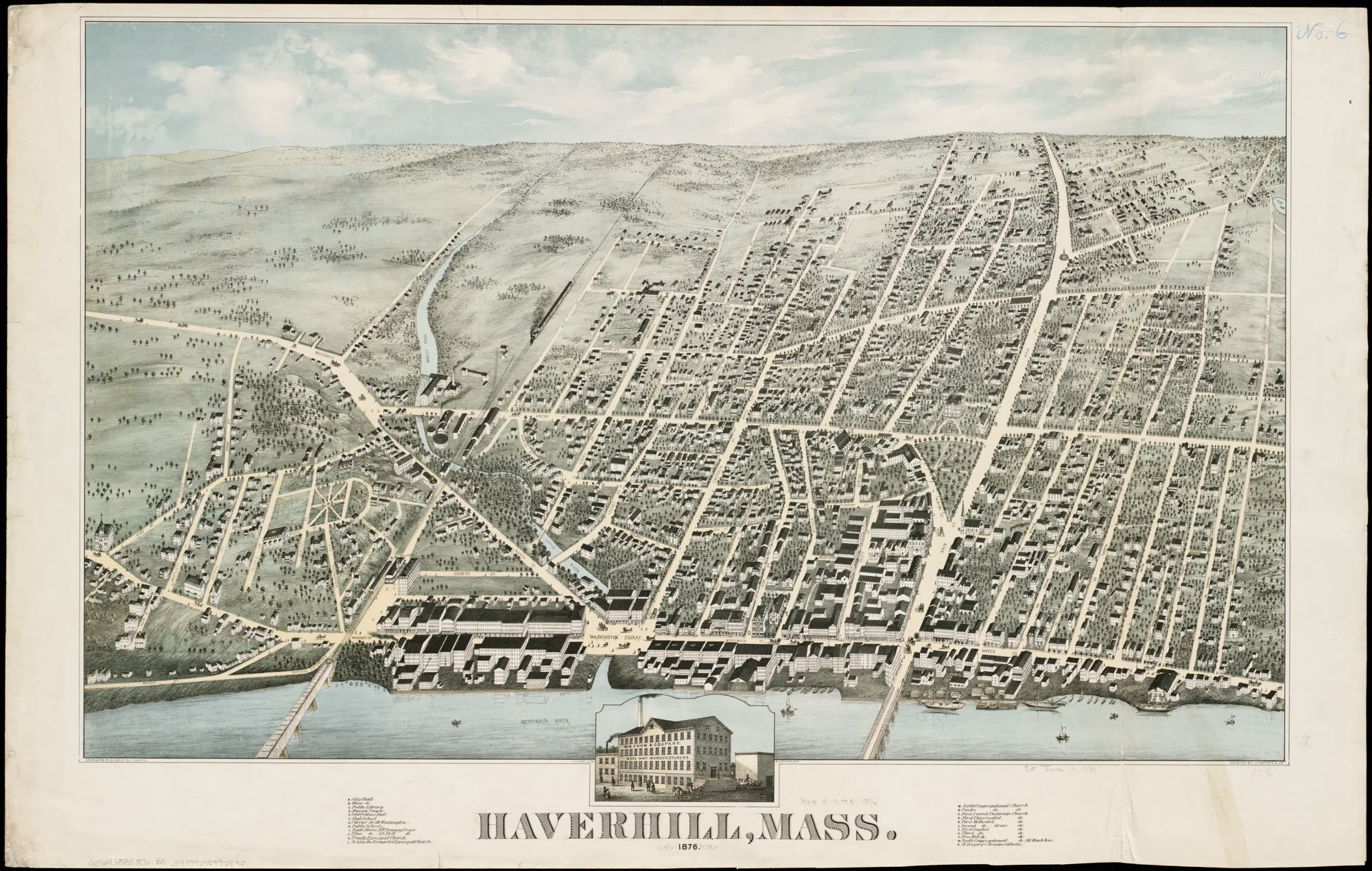
The river corridor, drawn as a sketch. Haverhill is the home pin. Boscawen island is the traditional site of the killing, at the mouth of the Contoocook: Hannah Duston Memorial State Historic Site, 298 US Route 4, about 43°17′ N, 71°35′ W. The words at the top are Mather’s destination, and they are deliberately not a dot. Worcester is where the boy was taken about a year and a half before. Boston is where the bounty was asked.Haverhill in 1876, not in 1697. H. H. Bailey and J. C. Hazen, bird’s-eye view. The town Hannah knew was a frontier settlement on the Merrimack, begun in 1640 by people from Newbury on land bought in 1642 under the name Pentucket, then renamed for the English Haverhill. By 1876 it was a city. The river in the view is the same corridor. Public-domain scan; the original is at the Norman B. Leventhal Map Center.
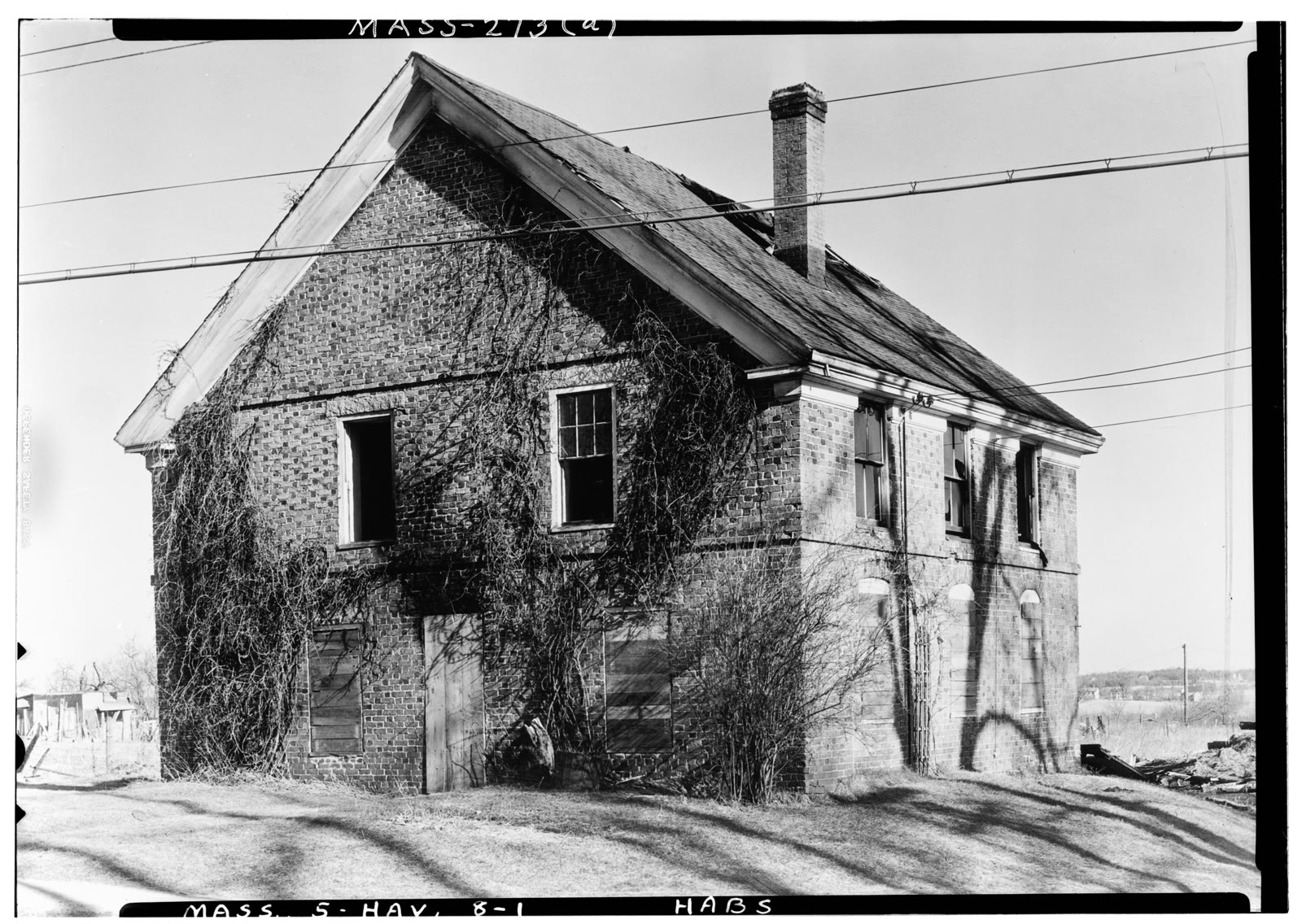
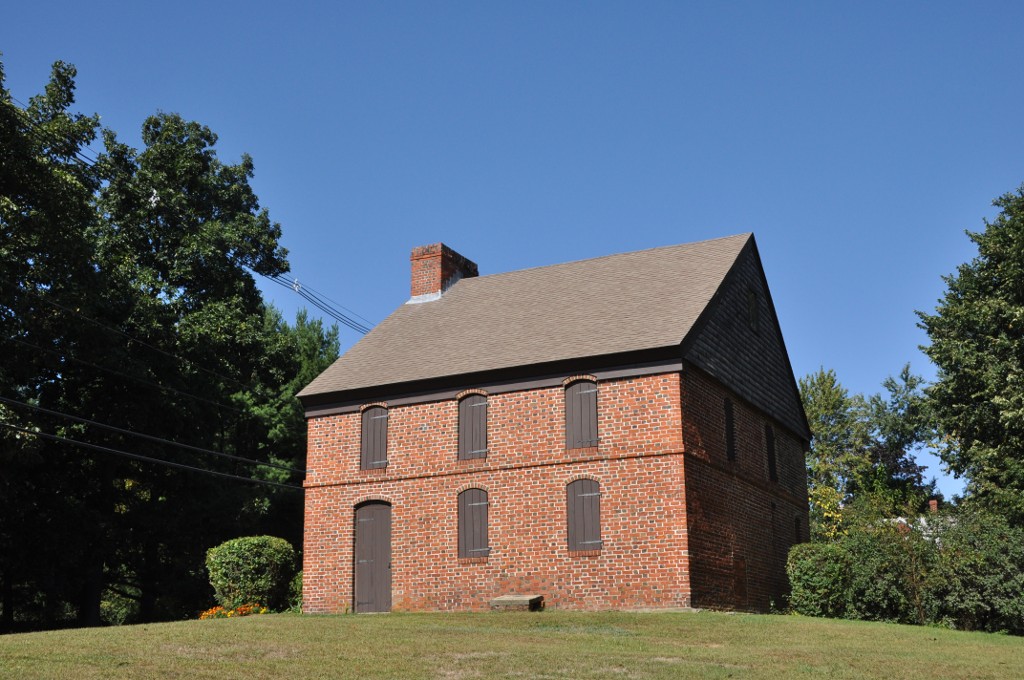
Duston Garrison House, Haverhill. 665 Hilldale Avenue. Finished around 1700. National Register 90000227. Arthur C. Haskell for the Historic American Buildings Survey, after 1933. The house in this picture is later than the raid.20The same house in 2012. Photograph by Magicpiano, 19 September 2012, CC BY-SA 3.0. A repaired building, not a 1697 view. Camera location matches the Commons coordinate for the house, 42°47′47″ N, 71°06′41″ W.
The cast
The people in the account
A small household, two other captives, the family that held them, and the minister who wrote it down. No names are added from Victorian books. Robert Boody Caverly’s 1875 telling invents dialogue that is not in any primary source, and it is not used here.
A Haverhill mother of a large family, about forty when she was taken, a week out of childbed. She lived another forty years, quietly enough that the famous part is one month. She asked for full church membership in 1724. She did not write the story. Mather did.
Mather has him tell seven of his eight children, ages two to seventeen, to run for a garrison. He will not choose one child to throw onto the horse and leave the others, so he stays at the rear of the whole string, fires back, and they reach safety a mile or two off. Later tellings add a horse and a brick house.20 He is the one who later petitions for the bounty, because a wife could not.8
Captive
Mary Neff
Widow, and Hannah’s nurse
Later identified as Mary Corliss
Born
1646, per Wikipedia
Died
17 October 1722, Haverhill, per Wikipedia
In the account
taken with the newborn
Mather names her. She tries to get the baby away and is taken. She is with Hannah and the boy on the night of the killing, and the province pays her a share of her own.13
Captive
Samuel Lennardson
The English youth in Mather’s account
Name from later writers, not from the fetched Mather text
He had already been a captive when Hannah arrived. The three of them used hatchets. Sewall, writing what Hannah told him on 12 May, says Samuel killed the man who had shown him, the night before, how to take a scalp.7 The name Lennardson is later writers’, not Mather’s. Sewall spells it Lenarson.12
They prayed morning, noon, and night, Mather says, in obedience to instructions the French had given them, and would not let the women pray in English if they could stop them. The master, watching the captives sink, tells them that if their God means to deliver them, they will be delivered. Ten of this family were killed in their sleep. One woman escaped wounded. One boy ran. Children were among the dead. Their names are not in the account this page trusts, and they are not invented here.
“That Indian Family consisted of Twelve Persons; Two Stout men, Three Women, and Seven Children”
Cotton Mather, Decennium Luctuosum (1699)
The teller · not a relative
Cotton Mather
Boston minister, 1663–1728
The near-primary printed source
1697
sermon, Humiliations follow’d with Deliverances
1699
Decennium Luctuosum, Article XXV
1702
Magnalia Christi Americana, Book IV
He is horrified by the baby’s death and unembarrassed that children were among the ten who were killed. He sets Hannah beside Jael. He also records that the Native family prayed three times a day. Both of those belong in the chapter. He is not an eyewitness of the night. Hannah is said to have heard him preach the story that May.11
The telling
What the early account says, and what came after
Told in the order it happened: a family in a frontier town, a raid, a march, a night, a payment, a long rest of a life, and then a century that turned her into a statue. The scalping is not the only thing she was. It is also not softened.
The Emersons and the Dustons in Haverhill
Haverhill sat on the Merrimack, a last line of English houses rather than a safe town. It had been bought in 1642 from Native sellers under the name Pentucket and renamed for the Suffolk parish the minister John Ward came from. By Hannah’s childhood it had already learned what a raid was. She was born there on 23 December 1657.1
The Emerson household later drew a scandal that was not charged to her.10 It is family context, and then it should be left. It is not why she was taken.
In 1677 she married Thomas Duston. He farmed and made brick.2 By the spring of 1697 Mather counts eight living children between two and seventeen, and a newborn.4 The line that reaches Glen runs through Jonathan, a small child in that house, not the baby killed on the road.
15 March 1697
King William’s War had been going since 1689. It was the American face of a European war, and it was also a border war of its own. After King Philip’s War, many survivors from southern New England had gone north and joined Abenaki and other nations allied with the French. Raiders struck English towns, killed some people, and carried others off to ransom or to adopt in place of their own dead. Massachusetts, for its part, had been paying for Native scalps.8 Both sides of this frontier were already counting the dead in money and in bodies.
Mather does not name a nation. He says “Salvages.” The usual historical label is an Abenaki raid from Quebec.21
“one Hannah Dustan, having lain in about a Week, attended with her Nurse, Mary Neff”
Cotton Mather, Decennium Luctuosum (1699)
Thomas was at work away from the house. He saw the attack in time to send the children running.
“first bidding Seven of his Eight children (which were from Two to Seventeen years of Age) to get away as fast as they could”
Cotton Mather, Decennium Luctuosum (1699)
He would not pick one child to throw onto the horse and leave the others, so he ran at the back of the whole string. The raiders fired. He fired back. They made a garrison a mile or two off. That is Mather. The horse under him, and the brick house under construction, are later additions.20
Mary Neff tried to get the baby away and was taken. Hannah was told to get up. She sat in the chimney and watched the house rifled and set on fire. About nineteen or twenty of the raiders led them off with about ten other English captives. On 4 June the court allowed Thomas, late constable, a discount on a treasurer’s order, “since burnt in his house” which “was destroyed by the Enemy.”8
“they dash’d out the Brains of the Infant, against a Tree”
Cotton Mather, Decennium Luctuosum (1699)
Other captives who could not keep the pace were killed the same way. The baby’s name is not in Mather.22 He is plain about what was done, and he is plain that it was done before they had gone many steps.
The march
Hannah and Mary walked about a dozen miles that night, then, in Mather’s figure, about 150 miles more or less over the next days. He says their health held, which he offers as providence. They were separated into one family of twelve: two men, three women, and seven children, plus the English boy already living with them, taken at Worcester about eighteen months before.12
Mather says this family prayed three times a day and would not let the two women pray in English if they could help it. The master, watching them sink, told Hannah not to trouble herself.
“What need you Trouble your self? If your God will have you delivered, you shall be so!”
Cotton Mather, Decennium Luctuosum (1699), the master’s words as Mather reports them
They were not at the end of the journey. The family was taking them to a town somewhere beyond Penacook, where, in Mather’s phrase, “they must be Stript, and Scourg’d, and run the Gantlet.”
The island where the Contoocook enters the Merrimack is where nineteenth-century memory parked the story, and where New Hampshire put the statue. It is the traditional site. It is not a place Mather mapped.6
Before dawn
Mather’s night is 30 April 1697.5 A little before day, still about a hundred and fifty miles from the town beyond Penacook, one of the women decides to do what Jael did to Sisera. His argument, put in her mouth, is that where no law will protect her life, no law forbids her taking the lives of the people who killed her child. She, the nurse, and the youth take hatchets. Ten die.
“to imitate the Action of Jael upon Sisera”
Cotton Mather, Decennium Luctuosum (1699)
“Only one Squaw escaped sorely wounded from them, in the Dark; and one Boy, whom they Reserved Asleep, intending to bring him away with them, suddenly wak’d”
Cotton Mather, Decennium Luctuosum (1699). “Squaw” and the rest are his words, not this page’s.
“cutting off the Scalps of the Ten Wretches, they came off, and Received Fifty Pounds from the General Assembly of the Province”
Cotton Mather, Decennium Luctuosum (1699)
“The single man shewed the night before, to Saml Lenarson, how he used to knock Englishmen on the head and take off their Scalps; little thinking that the Captives would make some of their first experiment upon himself. Sam. Lenarson kill’d him.”
Samuel Sewall, diary, 12 May 1697, in Diary of Samuel Sewall, vol. 1 (Massachusetts Historical Society, 1878), p. 453. His spelling. He says she told him this.
That is Mather’s core. Three captives killed ten people in a sleeping family that included children, scalped the dead, spared one boy on purpose who then woke and escaped, and one woman got away wounded.
Two other diaries, read for this page, do name a hand, and they do not agree. Sewall had Hannah in his house on 12 May and wrote down what she told him. Marshall, in Braintree, heard that the woman whose child had been killed then killed that captor.7
The way home, in the later tradition, is a canoe, traveled by night, down the Merrimack to Haverhill. Mather does not describe that trip.6
Home, and the bounty
They came back to Haverhill with the scalps. Mather says the General Assembly paid fifty pounds, and that private gifts came too. The vote of 16 June splits that fifty pounds. The law that would have required it had already lapsed, and a wife was paid through her husband.8
“unto Thomas Dunston of Haverhill, on behalf of Hannah his wife, the sum of twenty-five pounds; to Mary Neffe, the sum of twelve pounds ten shillings; and to Samuel Lenearson, the sum of twelve pounds ten shillings … as a reward for their service in slaying divers of those barbarous salvages.”
General Court vote, approved 16 June 1697, Acts and Resolves, Public and Private, of the Province of the Massachusetts Bay, vol. 7 (1892), pp. 153–154. The headnote on that page spells the name Dustun.
She was a story in Boston before she was a statue anywhere. Mather preached it on 6 May, with Hannah said to be present.11
The rest of her life
The famous month is not the rest of the life. She went home to a town that was still a target. Haverhill was hit again in 1704, 1707, and, hardest, in 1708.19 There may have been another child after the raid.22 Jonathan, the son this family descends through, lived to 1757 and died at Salem, New Hampshire, on the FamilySearch tree.
Hannah rarely took communion until late. In May 1724 she asked to be admitted to full membership in the Haverhill Center Congregational Church.14
Thomas died sometime between 1724 and 1732.15 She is said to have lived afterward with Jonathan in southwest Haverhill. When she herself died is an open argument, and this page will not pick a winner. She died in the mid-1730s.9
Mary Neff died at Haverhill on 17 October 1722.13 Samuel died on 11 May 1718.12 A hatchet and a knife said to be hers are in a Haverhill museum.23
How New England remembered her
From 1697 to 1702 the story is Mather’s: providence, Jael, and a war he understands as God’s. Then a long quiet. Cutter says that after 1702 it dropped out of mind until the 1820s.
When it came back, the country was in a different argument. Dwight in 1821, then Whittier, Hawthorne, Thoreau. Hawthorne, as Wikipedia paraphrases him, flinches at the children. Whittier, in the same kind of paraphrase, makes her an avenger. Thoreau stays closer to the early sources. The revival coincides with Indian removal and western expansion, and the killing of Native children was written out of many retellings. Stearns in 1847 paints a night scene for galleries and leaves the Native children out of it.7 The painting on this page is that picture. It is not a window onto 1697. Caverly’s 1875 book, written to raise the Boscawen statue, adds names and speeches the primary sources do not have.
The statues followed the books. A marble column at the Haverhill capture site in 1861 was sold off to Barre in 1865 and became a Civil War memorial. On 17 June 1874 the island statue was dedicated: a woman with a hatchet and scalps.16
The Haverhill bronze came in 1879, in the park on the site of her church.17
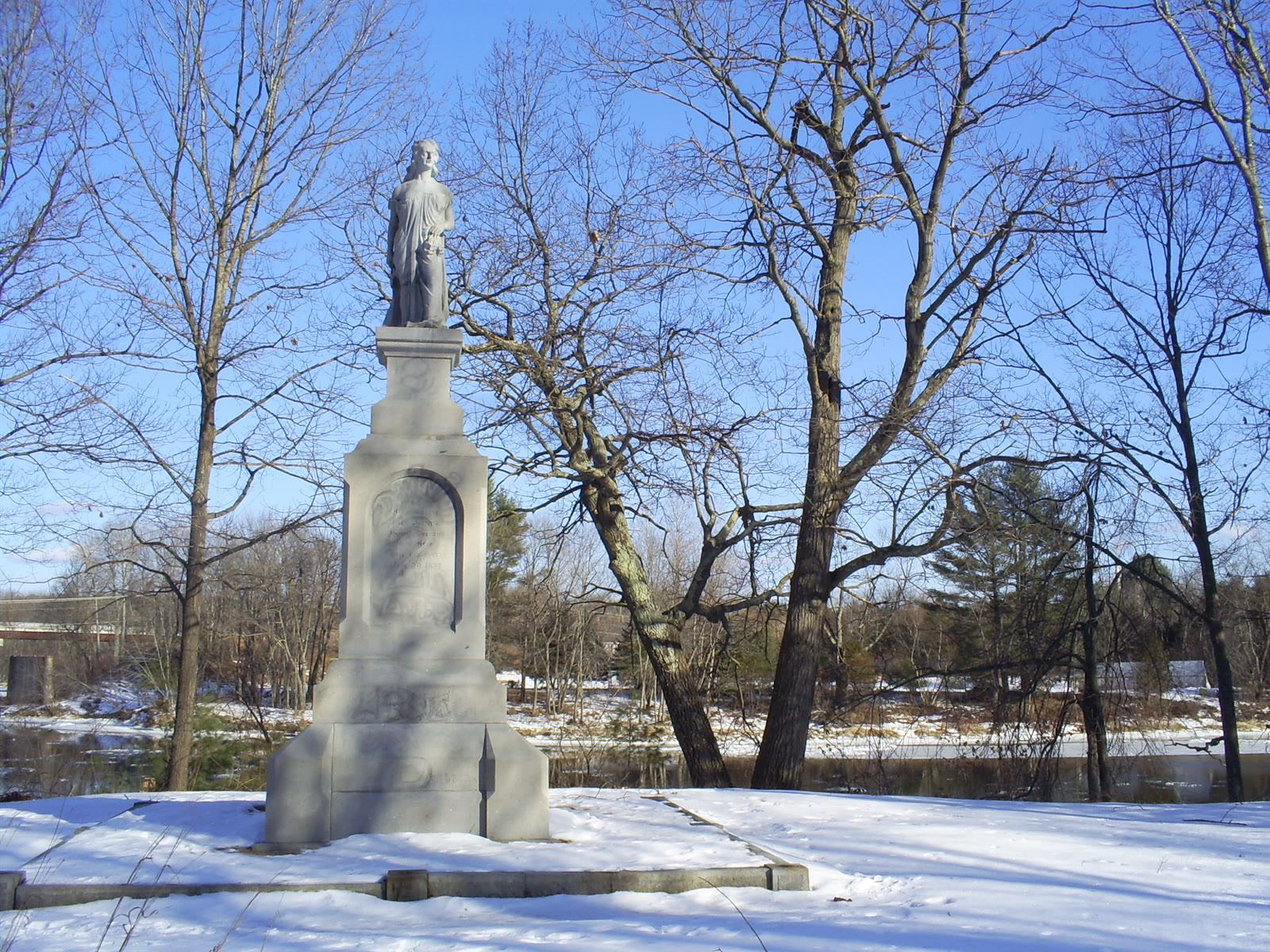
Boscawen, 1874. William Andrews. Photograph by Craig Michaud, 2009, CC BY 3.0. New Hampshire historical marker 49 stands in town and dates her 1657–1737, which is one side of the death-date argument, not a finding.9Haverhill, 1879. Calvin H. Weeks, Grand Army Park. Photograph by SeñorBrett, 20 March 2022, CC0. The base in this picture still carries the nineteenth-century wording.
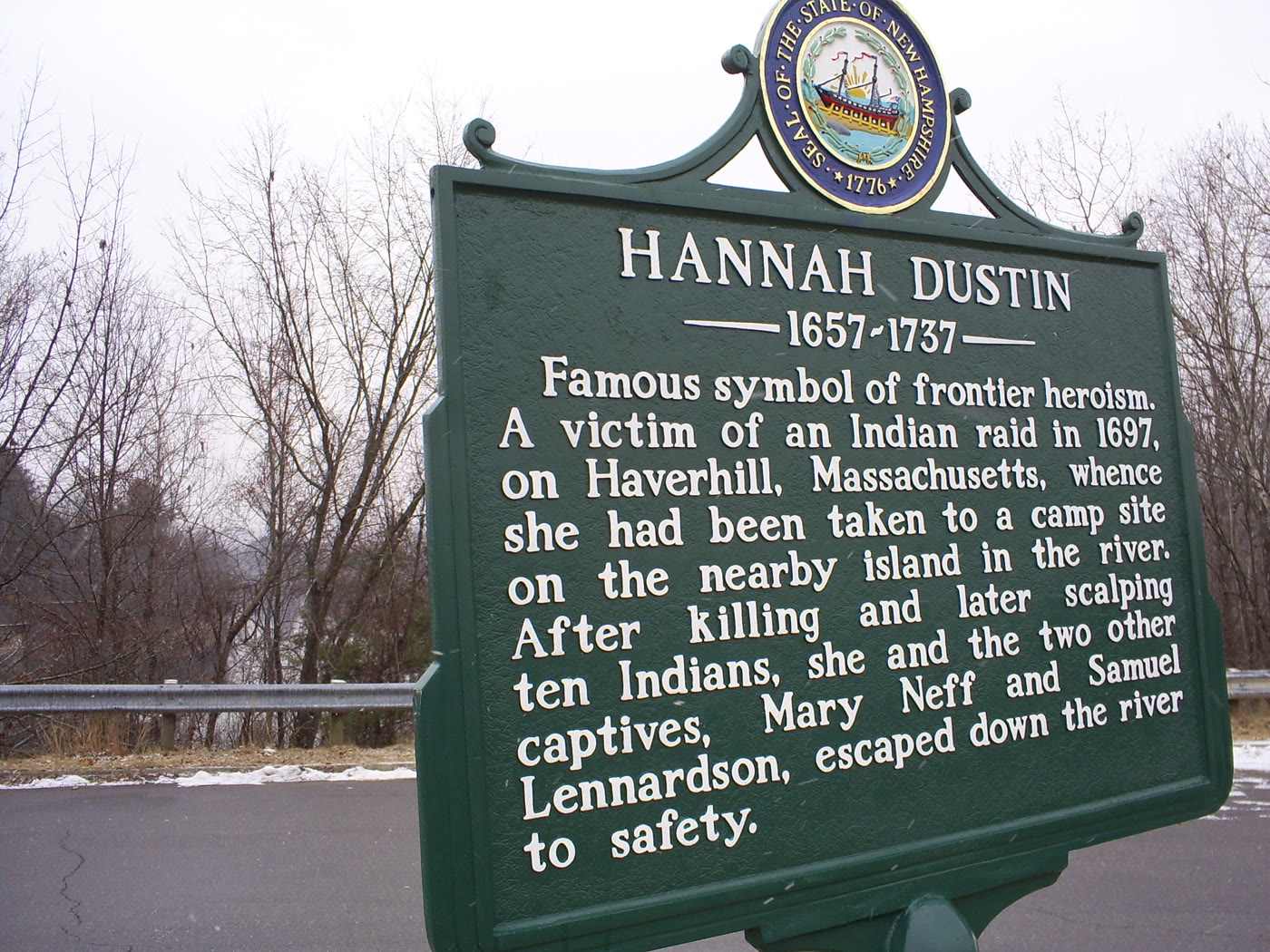
How the state told it. Marker 49 at Boscawen, photograph by Craig Michaud, 2008, CC BY 3.0. It calls her a famous symbol of frontier heroism, puts the camp on the nearby island, and has her escaping down the river with Mary Neff and Samuel Lennardson after ten people were killed and scalped. Useful as a picture of memory. Not a primary source. The death year on the sign is 1737.
The fair short version, for a family page, is this. A real attack hit a town, and a real killing followed, of a sleeping family, children included, by people who had just lost a newborn and had been told the gauntlet was waiting. Colonial New England paid for scalps and preached the killing as deliverance. Nineteenth-century Americans put a woman with a hatchet on a pedestal while the United States was taking Native land. Abenaki and Pennacook descendants, and many people in Haverhill and Boscawen, now read the statues as monuments to that second story as well as to hers.
The Cowasuck Band of the Pennacook-Abenaki have asked to be remembered on the same island.18 Haverhill’s council voted to keep the bronze. In New Hampshire, a 2026 bill to remove the Boscawen statue was voted down in February. Some Abenaki leaders, reported by New Hampshire Public Radio in December 2025, said the history should remain and the Indigenous side should be added, not erased. The page can hold that without a verdict. The sentences that have to stay are already in the opening note: the baby was killed; children were among the ten who were killed and scalped; the province paid for it; later Americans used the story while they were dispossessing Native nations; Abenaki descendants have asked to be remembered on the same island.
Descent
From Hannah to Todd, on Glen’s line
Hannah Emerson Duston is Todd Spencer Hopkinson’s 9th great-grandmother. The line is Glen’s only, through Vivian Hamblin. It does not appear on Pam’s branch. Counted the other way: she is Glen’s 8th great-grandmother, and a 10th great-grandmother to Glen and Pam’s grandchildren.
The chain was read in the FamilySearch relationship view on 4 October 2026, from Todd’s record. Jonathan is the first generation descending from Hannah. Thomas, her husband, is not a step in the list. Birth and death places are as FamilySearch showed them that day. They are tree data, not fresh abstracts from the vital records. Hannah’s FamilySearch death, 6 March 1736 at Ipswich, is one side of the dispute described above, not a settlement of it.
Hannah Emerson Duston → Todd 12 people · Glen’s Hamblin line
Hannah Emerson (Duston)— 23 Dec 1657, Haverhill, Massachusetts Bay; died in the mid-1730s (FamilySearch: 6 Mar 1736, Ipswich). L5BR-BYD. Todd’s 9th great-grandmother.
Jonathan Dustin— 1692, Haverhill, to 1757, Salem, New Hampshire. Son of Hannah and Thomas. The continuing child, not the newborn killed in 1697. LHRX-VSW
Mehitable Dustin— 1715, Haverhill, to 1740, Haverhill. LHQ9-LFR
Miriam Marsh— 1740, Haverhill, to 1823, North Hero, Vermont. LHTL-CXN
William Haynes— 1769, Bennington, New Hampshire, as FamilySearch shows it, to 1804, North Hero, Vermont. LZZ2-GGJ
Daphne Haynes— 1797, North Hero, Vermont, to 1847, Council Bluffs, Iowa. KWJY-NSN
Oscar Hamblin— 1833, Bainbridge, Ohio, to 1862, Minersville, Utah Territory. KWVH-ZF7
Wallace Hamblin— 1862, Santa Clara, Utah Territory, to 1937, Lyman, Wyoming. KWZ9-CMD
Vivian Hamblin— 1918, Millburne, Wyoming, to 1999, Mesa, Arizona. KWCL-WCM
Glen Spencer Hopkinson— 1946, living; birthplace not shown on FamilySearch. LFPX-DZ3
Todd Spencer Hopkinson— 25 June 1975, Cody, Park County, Wyoming. KWH7-P9F
Thomas Dustin Jr. (LTMX-YM1) is Hannah’s husband: FamilySearch has him born 1652 at Portsmouth, New Hampshire, married 3 December 1677 at Haverhill, died 1732 at Haverhill. He is not a generation of descent. The same early-Massachusetts cluster, for a later page and not expanded here, includes Joshua Emerson (MF94-MWS), Mary Clark (LCLZ-PKB), Elizabeth Watts (LZNG-7RS), and Jonathan Marsh (L8Q1-KTF), along with Thomas, Jonathan, Mehitable, and Miriam.
Sources
Where this came from
Quotations are only lines read in a printed edition or a page image of one: Mather’s reprints, Sewall’s diary (1878), Pike’s journal (1876), Marshall’s diary extracts (1900), and the 1892 Acts and Resolves. The 1724 church letter was not opened in a reliable transcription, and it is not quoted. FamilySearch IDs were checked 4 October 2026.
FamilySearch
Open any person at familysearch.org/tree/person/details/ followed by the ID. Living people’s records are private except to family signed in on the tree.
Cotton Mather, Decennium Luctuosum (1699), Article XXV, “A Notable Exploit,” as reprinted with original spelling in DeRosa, Goode, and others, The Open Anthology of Earlier American Literature, on LibreTexts (CC BY-SA 4.0). The reprint used.
The same chapter in modernized spelling, with OCR errors, in the Maricopa Renewable Anthology of Early American Literature, presented there as the Magnalia text and as public domain via HathiTrust. It agrees on the story and on 30 April. The reprint used.
Mather also printed the story in a sermon of 6 May 1697, Humiliations follow’d with Deliverances, and in Magnalia Christi Americana (London, 1702), Book IV. Those printings were not opened as page images for this page.
Samuel Sewall, Diary of Samuel Sewall, 1674–1729, vol. 1, Collections of the Massachusetts Historical Society, 5th series, vol. 5 (Boston, 1878), pp. 452–453. Internet Archive diaryofsamuelsew01sewaiala, pages 452–453 read from the scan.
John Pike, journal, edited by A. H. Quint, reprinted from the Proceedings of the Massachusetts Historical Society, vol. 14 (Cambridge: John Wilson and Son, 1876). The 15 March 1696/7 entry. journalofrevjohn00pike.
John Marshall, Extracts from John Marshall’s Diary, January, 1689 – December, 1711, edited by Samuel A. Green (Cambridge: John Wilson and Son, 1900), p. 18. extractsfromjohn00mars.
The Acts and Resolves, Public and Private, of the Province of the Massachusetts Bay, vol. 7, Resolves, 1692–1702 (Boston: Wright & Potter, 1892), pp. 151, 153–154, and the note at p. 562. actsresolvespubl_m07mass.
Still not quoted
The 17 May 1724 church letter at the Haverhill Historical Society. Web copies, including a 1978 local pamphlet, were not treated as a scholarly transcription.
Vital Records of Haverhill, for the marriage day, the infant’s name, Lydia’s birth, and the deaths.
Wikipedia, “Hannah Duston,” “Haverhill, Massachusetts,” and “Hannah Duston Memorial State Historic Site,” as read in the research pass of 4 October 2026. Secondary. Used for names, monuments, and disagreements, and labeled when a diary was not opened.
Barbara Cutter, “Why an American Woman Who Killed Indians Became Memorialized as the First Female Public Statue,” Zócalo Public Square, 9 April 2018. Her scholarly article, “The Female Indian Killer Memorialized,” Journal of Women’s History 20, no. 2 (2008), was not opened.
George Wingate Chase, History of Haverhill (1861), and Robert Boody Caverly, The Heroism of Hannah Duston (1875), are local and Victorian tellings. Caverly is not a source of new facts on this page.
Images
Junius Brutus Stearns, Hannah Duston Killing the Indians, 1847. Wikimedia Commons file Stearns-hannah-duston.webp. Public domain (published before 1931; Stearns died in 1886). Not an eyewitness view. He painted the boy as a woman and omitted the Native children. Resized for this site.
Mrs. Dunstan Escaping Down The Merrimac, American school, about the 1870s. Commons file of that title. Public domain in the United States as published before 1931. The title misspells the name. A later imagining of the canoe trip, which Mather does not describe.
Boscawen statue and the state marker: photographs by Craig Michaud, 2009 and 2008, CC BY 3.0. Attribute Craig Michaud. Resized copies.
Haverhill statue: photograph by SeñorBrett, 20 March 2022, CC0 1.0. Turned upright from the camera’s stored orientation and resized.
Duston Garrison House: Arthur C. Haskell, Historic American Buildings Survey, HABS MA-273, after 1933. Public domain as a work of the National Park Service. Resized from the Commons TIFF.
Dustin House, 19 September 2012, Magicpiano, CC BY-SA 3.0. Copied without change from Commons.
Bird’s-eye view of Haverhill, 1876, H. H. Bailey and J. C. Hazen. Public domain. Source: Norman B. Leventhal Map Center. Resized. It shows the city of 1876, not the village of 1697.
The river map on this page is a schematic drawn for the page. It is not a chart, and it is not to scale.
The disputes stay here, out of the story. The diary and court lines are just below, so the timeline does not have to carry them.
What the diaries and the court said
Spellings are the printed editions’. Square brackets in Sewall are the 1878 editors’, not his words.
“April 29. 5th day is signalised by the Atchievement of Hanah Dustin, Mary Neff, and Samuel Lenerson; who kill’d Two men [Indians], their Masters, and two women and 6. others, and have brought in Ten Scalps.”
Sewall, diary, 1878, p. 452. His date is 29 April. Mather’s is 30 April.
“Hanah Dustan came to see us; I gave her part of Connecticut Flax. She saith her Master, whom she kill’d, did formerly live with Mr. Roulandson at Lancaster: He told her, that when he pray’d the English way, he thought that was good: but now he found the French way was better.”
Sewall, 12 May 1697, 1878, p. 453. The scalp sentence in the story is the next lines of this same visit.
“Mar: 15, 967. The Indians fell upon some part of Haverhill, about 7 in the morning, killed & carried away 39 or 40 persons — two of these Captive women, viz. Dustan & Neff (with another young man) slew ten of the Indians, & returned home wth ye scalps.”
John Pike, journal, Quint’s 1876 reprint. The raised 7 is the double date, 1696/7. ye is “the.”
“[March] on the 14 day the indians did much damage at haverill. burnt 9 houses killed and took Captive near 40 persons young and old.”
John Marshall, diary, Green’s 1900 extracts, p. 18. The month in brackets is Green’s. He prints the 14th, not Mather’s 15th, and nine houses, not half a dozen.
“[April] at the Latter end of this month 2 women and a young Lad that had Been taken captiue from Hauerill in march before: watching their opertunity when the indians weer asleep killed ten of them. scalped them all and come home to boston.”
Marshall, same page. He gives no day in April.
“the cheif of thees indians took one of the women captiue when she had Layen in childbed but a few days: and knocked her child in head before her eyes: which women killed and scalped that very indian”
Marshall, the same April entry. This is not how Sewall splits the killing.
“in the just Slaughter of soe many of the Barbarians, as would by the Law of the Province wch expired a few months agoe, have entitled the actors unto a Considerable Recompence from the Publick.”
Petition of Thomas Dunstan of Haverell, printed in the 1892 Acts and Resolves, vol. 7, p. 562, from Massachusetts Archives, vol. 70, p. 350. The editors’ transcription, not the manuscript. They note the signature was written Dustun, with an n interlined later.
The numbered notes are the disputes. The quotations above are the lines actually read.
Wikipedia names her parents Michael Emerson and Hannah (Webster) Emerson, and calls her the oldest of fifteen children. Britannica and Wikipedia agree on 23 December 1657 at Haverhill. ↩
Britannica gives 1677. FamilySearch records the day as 3 December 1677 at Haverhill. That day was not checked against the printed Haverhill vital records, and his parents are not treated as confirmed here. ↩
Mather says about thirty-nine people killed or taken, and about half a dozen houses burned. A later summary says twenty-seven killed, about half of them children, and thirteen carried off. Pike’s journal, opened in Quint’s 1876 reprint, says 39 or 40 killed and carried away. Marshall’s 1900 extracts say nine houses and near 40 persons, and date the raid the 14th. A later summary says twenty-seven killed and thirteen carried off. Do not collapse these into one number. The lines are quoted above. ↩
Mather counts eight children, ages two to seventeen, of whom Thomas tried to save seven, plus a newborn with Hannah and the nurse Mary Neff. Later retellings do not match him exactly. Jonathan, the continuing line, is 1692 on FamilySearch. ↩
This page follows Mather: 30 April 1697, a little before day. Britannica and a 1902 DAR marker at Nashua say 30 March. The Nashua stone also says they spent a night at John Lovewell’s; the marker was not read on site. Sewall’s diary, opened in the 1878 edition, dates the killing 29 April and the visit 12 May. Marshall says only the latter end of April. Britannica’s Boston presentation on 21 April conflicts with both Mather and the June vote. ↩
Mather does not name an island or a canoe. He still has them about 150 miles from a town somewhere beyond Penacook — stripped, scourged, and made to run the gauntlet. Tradition, and the 1874 statue, put the night on an island at the Contoocook’s mouth, Boscawen, a few dozen miles up the Merrimack from Haverhill, not 150. Britannica’s march of 100 miles is the same kind of story distance. The later trip home is a night canoe, with a possible stop at Lovewell’s in old Dunstable (now Nashua), and a 1902 millstone on the Haverhill shore for a traditional landing. None of that canoe is in the Mather text fetched here. ↩
Three captives killed ten people in a sleeping family that included children, scalped the dead, and had meant to keep one boy asleep. He woke and ran. One woman got away wounded. Sewall, from Hannah’s 12 May visit, says Samuel killed the man who had shown him how to scalp. Marshall says the woman whose child was killed then killed “that very indian.” Mather does not split the blows. Britannica’s “nine by Hannah” is not in any of these. Cutter’s detail, that the boy asked to be shown the blow at Hannah’s request, is not in the 1878 Sewall entry, and it is not adopted. Stearns’s 1847 painting turns Samuel into a woman and leaves the Native children out. ↩
Mather says fifty pounds from the General Assembly, plus private gifts, including one from Colonel Nicholson, governor of Maryland. The 1892 Acts and Resolves, vol. 7, pp. 153–154, prints the vote approved 16 June: £25 to Thomas Dunston on Hannah’s behalf, £12 10s to Mary Neffe, £12 10s to Samuel Lenearson. The note at p. 562 prints his petition from the archives: the scalp law had expired a few months before. The 4 June vote (p. 151) is the burned-house discount to Thomas Dunstan, late constable. The editors’ headnote uses Dustun. A wife had no separate legal standing, so the petition is his. ↩
Britannica: 1736?, at Ipswich, after a move there. Wikipedia: 6 March 1736, 1737, or 1738, at Haverhill, and a will possibly proved at Ipswich on 10 March 1736, which would make “Ipswich” a courthouse rather than a home. The Boscawen marker says 1657–1737. FamilySearch says 6 March 1736 at Ipswich, one side of the argument, not a verdict. She is said, after Thomas’s death, to have lived with Jonathan in southwest Haverhill. That is local history, not a proved death record. ↩
In 1676 Michael Emerson was fined for violence against a younger daughter, Elizabeth. On 8 June 1693 she was hanged for concealing the deaths of illegitimate twin daughters. A sister Mary was whipped for fornication in 1683. A cousin, Martha Toothaker Emerson, and Martha’s father were accused in the Salem witch trials. Wikipedia’s Haverhill article says there were never allegations of that kind against Hannah. ↩
Wikipedia says he preached the story on 6 May 1697, in Humiliations follow’d with Deliverances, and that Hannah was in the congregation. The sermon text was not opened here. ↩
Wikipedia: 1683–1718, of Preston, Connecticut, married, five children, died 11 May 1718; taken at Worcester in late 1695. Mather never gives him the name Lennardson in the text fetched here. He is “an English youth,” taken about a year and a half before. ↩
Wikipedia: born Mary Corliss, 1646; died at Haverhill on 17 October 1722. Her share, if the printed acts are right, was £12 10s. In 1739 her son Joseph was granted 200 acres at Penacook by New Hampshire “in consideration of his mother’s services.” That grant was not opened here. ↩
Thomas had petitioned in January. A letter of 17 May 1724, said to be in the Haverhill Historical Society, is quoted on Wikipedia and in a 1978 local pamphlet. No scholarly transcription was opened, so it is not quoted. The request can stand without the sentence. ↩
Britannica says Thomas died in 1732. Wikipedia allows sometime between 1724 and 1732. FamilySearch says 1732 at Haverhill. A compiled genealogy that kills him in 1698 is wrong: he is alive for the raid, and alive long after it. ↩
Wikipedia and New Hampshire State Parks say the figure is 35 feet, the first publicly funded statue in New Hampshire, often called the first American public statue of a woman. Cutter’s essay says 25 feet. This page uses 35 and flags the difference. William Andrews of Lowell. Dedicated on Bunker Hill day before nearly 5,000 people, Governor James A. Weston speaking, paid for by about 450 subscribers and $6,000 raised by Caverly. Wikipedia’s reading of the east inscription, not checked on the stone: “The war whoop, tomahawk, faggot & infanticides were at Haverhill / The ashes of wigwam-camp-fires at night & of ten of the tribe are here.” ↩
Calvin H. Weeks, in Grand Army Park, on the site of the church she joined in 1724. Wikipedia’s Haverhill article says the woolen manufacturer Ezekiel J. M. Hale paid for it. The single bare foot is later Haverhill folklore, from Mirick’s 1832 history, not from Mather. ↩
Wikipedia: the bronze was vandalized, including chalk calling it a monument to genocide, and the city council voted to keep it, change offensive wording on the base, and make room for a Native memorial. The council minutes were not opened here. The Cowasuck Band, as Wikipedia reports, have asked to add a memorial to the Abenaki dead on the island, and plaques along the river and the railroad that crosses to it. ↩
Wikipedia says the 1708 raid, under Jean-Baptiste Hertel de Rouville, killed sixteen, including the minister. ↩
Wikipedia adds that Thomas was on horseback about half a mile away, building a brick house. Those details are not in the Mather text read here. The brick house at 665 Hilldale Avenue is real, finished around 1700, and later than that morning. National Register 90000227. ↩
Britannica and Wikipedia call it an Abenaki raid of about thirty people from Quebec. Cutter says most were likely Abenaki. A later guess that the household was “probably Pennacook” is Wikipedia’s, not Mather’s. He says “Salvages,” and he does not name a nation. ↩
Later writing names the killed infant Martha. Wikipedia, citing a modern book, also names a daughter Lydia born 4 October 1698. Neither was confirmed here against Vital Records of Haverhill. They are not treated as settled. ↩
At the Buttonwoods Museum. Wikipedia calls the axe a Biscayan trade hatchet, not a tomahawk. That has not been verified in person. A hospital and a former elementary school in Haverhill have carried her name. Those are modern signs, not evidence from 1697. ↩